Showing posts with label aurora. Show all posts

Wednesday, 11 July 2018

Tuleva revontulikausi

Klikkaamalla saa parempi kartta.
Meille tulivat jo ensimmäiset kysymykset milloin voidaan katsoa taas revontulet. Vastaus riippuu leveysasteesta. Etelässä pimeys palautuu aikaisemmin kuin pohjoisessa.

Kuinka pimeää pitäisi olla? SGO:n tieteelliset kamerat toimivat kun aurinko on vähintään 10° horisontin alapuolella. Toki on mahdollista nähdä erittäin kirkkaat revontulet jo ennen sitä.

Yllä oleva kartta näyttää minä päivänä aurinko on kesän jälkeen ensimmäistä kerta 10° horisontin alapuolella Suomessa. Kannattaa muistaa, että kesäaikana yön pimein aikaa on klo 01 ympäri.

Meidän tieteelliset revontulikamerat eivät ole vältämättä näinä päivinä alkamassa mittauksinsa operatiivisista syistä.

Kartta ja teksti: Thomas Ulich, SGO.

Start of the Northern Lights Season

Click on map for better resolution.

Almost three weeks after the summer solstice, we start to get questions regarding when the Northern Lights can be seen again after the Polar Day. The answer depends on where you are: the further south you are, the earlier it will get dark enough.

How dark does it need to be? Our scientific cameras operate when the Sun is at least 10° below the horizon. However, if there are particularly bright Northern Lights, you might be able to see them already earlier.

The map above shows the days on which the Sun will be at least 10° below the horizon in Finland. Be aware, however, that due to summer time (daylight saving time), the darkest time of the night is around 01:00h in Finland.

Note further, that our scientific cameras will not necessarily be back on location on the first day that it is dark enough. Their annual maintenance might well delay the schedule.

Map and text: Thomas Ulich, SGO.

Friday, 8 September 2017

Revontulet 7.-8.9.2017 - Auroras 7.-8.9.2017

Auringossa 6.9. tapahtuneen roihupurkauksen (X9.3) yhteydessä tapahtui myös koronan massapurkaus (CME), joka saavutti Maan viime yönä ennen klo 02 aloittaen poikkeuksellisen voimakkaan geomagneettisen myrskyn. SGO:n magneettikentän rekisteröinneissä havaittiin hyvin nopeita muutoksia. Deklinaatiossa havaittiin noin 10 asteen poikkeaminen normaalista noin 12 asteesta. Kyseinen geomagneettinen myrsky saavutti aamu yöllä tason G4. Tarkemmin tästä Ilmatieteen laitoksen sivuilla:

http://ilmatieteenlaitos.fi/tiedote/411041112

Alkuillasta 7.9. pohjoisessa oli varsin rauhallisesti käyttäytynyttä revontulta ja itään vaeltavia Omega-muotoja, kunnes CME saapui. Ikävä kyllä, pian tämän jälkeen heti klo 02 jälkeen pilviverho saavutti myös SGO:n revontulikameran, mutta tätä ennen jo taivas ehti olla hetken aikaa täysin tulessa. 


Video on tehty SGO:n kuvavahvistimella varustettu koko taivasta kuvaavan revontulikameran kuvakomposioista joka minuutille. Kuviin on yhdistetty kolmella eri suotimella peräkkäin otetut kuvat (ks. Calibration of the All-Sky Cameras ).

Avaruussää jatkuu lähipäivät häiriöisenä ja Lapin taivaalla revontulia on tulevinakin öinä, tosin etelästä saapuva matalapaine on tuomassa pilviä ja sateita viikonlopulla.

Sodankylässä SGO:n oman revontuli- ja meteorikameriden rinnalla on jo toiminnassa on University College Londonin  Fabry-Perot interferometri, jonka yhteydessä on kalansilmä värikamera ja pilvisyyssensori sekä japanilaisten (ISEE, University of Nagoya) suurnopeuskamera sekä japanilaisen National Institute of Polar Researchin (NIPR) kamerat.

Muut AurorasNow!-palvelun Lapin revontulikamerat käynnistetään lähiaikoina.

SGO:n revontulikameran alkusyksyn revontulia voi tarkastella SGO:n data-arkistosta, jonne jokaisesta havaintoyöstä on tuotettu videot vuodesta 2000 lähtien.


Tuesday, 7 February 2017

Northern Lights 31st January / 1st February 2017

[Helsingin Sanomissa 7.2.2017: "Revontulet sykkivät mystisesti" -artikkeli SGO:n ja Japanilaistutkijoiden välisestä tutkimusyhteistyöstä.]

Last week beautiful northern lights were seen across large parts of Northern Finland and Scandinavia. Already early in the evening after 19:00 EET (17:00 UTC), the lights appeared and by 21:00 EET the sky was filled with what we call "pulsating aurora". This form of aurora displays large patches of diffuse green light, which are flickering at various speeds, some flicker very fast. Pulsating aurora is very much a topic of active research, and our Japanese colleagues just launched the ARASE (ERG) satellite to study these specific lights from space. These efforts are combined with optical studies on the ground, and just in time for last week's northern lights, a special high-speed camera was installed at SGO, which can take up to 100 photos of the aurora per second!

From Sodankylä, four films of the aurora during the night of 31st January / 1st February have recently been published, two of which are from SGO:

The video above was made by taking all of the images of the regular all-sky camera of SGO, which are black-and-white images taken through filters for the auroral green, red, and blue lines, and combine these to create RGB (false) colour images. Images are taken every 20 seconds, and thus the video linked above is a time-lapse of the whole night, which is just 1min 30 sec long. (©2017 by SGO)

The video linked here is a result of a collaboration between SGO and Site-Eye Ltd., UK. Site-Eye have installed two long-term time-lapse cameras at SGO, one looking at the sky at a northerly direction, the other looking west across the river Kitinen. This video combines images from both cameras. (©2017 by SGO and Site-Eye Ltd)

The video above was taken by SGO's Thomas Ulich, who placed a camera looking almost straight up, with a slight tilt towards the south. This is the best direction to see what is called the auroral corona, a display, where the auroral rays all seem to originate from the same point in space. This is, however, just a result of perspective: the rays are in fact parallel. Images taken over 9 hours at a rate of four photos per minute were combined into a time-lapse film of about one minute duration. (©2017 by Thomas Ulich, see his blog post)

In the final video of this series, which was taken by SGO's Esa Turunen using a fish-eye lens to cover as much sky as possible, you can see the shapes of pulsating aurora especially well. They are patches drifting across the sky and flickering at the same time. The images were taken at a rate of approximately one per second. (©2017 by Esa Turunen)

Please note that in all videos linked here, the flickering of the aurora is aliased by the number of time per minute the images were taken as well as by the frames-per-second rate of the final time-lapse films.

Thursday, 25 August 2016

Northern Lights Season has started!


The photo above was captured last night (24th August 2016, at 21:00 UTC (00:00 EEST) by one of the time-lapse cameras we operate jointly with Site-Eye Ltd, UK. The night sky is still too bright at the latitude of Sodankylä to get good contrast, but the season has definitely started. The scientific auroral all-sky camera will return in the near future for real-time monitoring. In the meantime, the time-lapse camera can be used for a look to the north from Sodankylä.

Photo: Site-Eye/SGO, text: Thomas Ulich.

Monday, 16 May 2016

April Aurorae


Recently, we reported about a new long-term time-lapse project at SGO. Today, we have received the summary video of the Northern Lights in April. The video above works best in full screen and high definition.

Also, we now have live feeds from the time-lapse cameras to SGO's web pages, which allow you to check the current weather conditions in real time. The images are updated once per minute.


As an example, here's what our river camera sees at the moment. You see both images on on their dedicated live-feed page. Enjoy!

Text: Thomas Ulich; image and film: Site-Eye Ltd.

Friday, 4 December 2015

Northern Lights


It's been very cloudy this past month, with few clear nights. Often we saw in our instruments that there must have been brilliant lights on the other side of the clouds, but on the ground there was no chance to see anything. Then, on Wednesday evening (2nd December), there were gaps in the clouds and for a brief moment the lights appeared...

With this photo we wish all of you a very good weekend, and those of you in Finland a very good Independence Day on 6th December, when Finland will turn 98. Hyvää Itsenäisyyspäivää!

Photo: Thomas Ulich.

Friday, 11 September 2015

Aurora pictures 09.09.15

A couple of nights ago, a geomagnetic storm sparked very bright and dynamic aurora over Sodankylä, which lasted for most of the night. Here are a couple of pictures taken from behind the local airport.

At first, it was a bit cloudy, but soon enough the sky became perfectly clear and it was possible to fully enjoy the live show. It went really crazy around 01:00 LT, with very bright pinkish displays below the green arcs, pulsating aurora and dancing structures.


Photos: M. Grandin.

Wednesday, 26 August 2015

All-sky operations started with night time thunder storm

Last night was first observation night with the camera capable to observe the Northern Lights at SGO site station. The observation time is about 4 hours. Instead of the Northern Lights we captured lightning strokes, which is really rare in Sodankylä this time of year when the nights are dark. Past couple weeks has been warmest weeks of the past summer. This ended with cold front travelling over Sodankylä forming heavy thunder shower. The long exposure allowed multiple lightnings in the same frame. The present solar wind conditions provides good change to capture the Northern Lights in the coming night! Other SGO imagers are now in calibration and will be in operation after calibration.

Lightning strikes in UCL Colour image at SGO.

Monday, 17 August 2015

Northern Lights Season has started

The first northern lights of the season have been spotted as far north as Sodankylä last night. This has raised the question on when it is dark enough to see them. The northern lights are comparable in brightness to the stars: if you can see the stars, you would see also northern lights, even if the contrast against the bright sky is still very low.

In more definite terms, for the night to be dark enough, the Sun should be some 8°–9° below the horizon. For our scientific all-sky cameras, the limit is -10° solar elevation for at least a couple of hours. This means that it is turned off in mid-April, and could be deployed in autumn as early as late August, but in practice this depends on operational matters, since all cameras are recalibrated and serviced every autumn, which is a collaborative effort with colleagues from other institutes.

In order to give you an idea when the aurora season starts at various latitudes in Finland, we have computed the time of sunrise and sunset as well as the start and end of civil, nautical and astronomical twilight. These are plotted below in "length-of-day/night" diagrams (click to enlarge) for the locations of Utsjoki, Sodankylä, Oulu, Jyväskylä, and Helsinki. The green line in those plots refers to the -10° elevation limit of the auroral camera. These diagrams are explained in somewhat more detail in our article about the Polar Day.

Twilight refers to the time when the Sun is below the horizon, but it is not completely dark. Civil twilight refers to the Sun being between the horizon and -6° elevation. During civil twilight, observations of stars and aurora are possible only using special equipment. When the Sun is between 6° and 12° below the horizon, we speak of nautical twilight, and when the Sun is between 12° and 18° below the horizon we call it astronomical twilight. Once the Sun reaches -18° elevation (18° below horizon) we have complete darkness. Note that this does not happen in Utsjoki before mid-September. But even in Utsjoki, the northern lights season will start in about a week.

Happy aurora hunting!

Length of Day/Night at Utsjoki (click for larger image)

Length of Day/Night at Sodankylä (click for larger image)

Length of Day/Night at Oulu (click for larger image)

Length of Day/Night at Jyväskylä (click for larger image)

Length of Day/Night at Helsinki (click for larger image)

See also: Polar Day.

Wednesday, 22 April 2015

Polar Day Ahead!


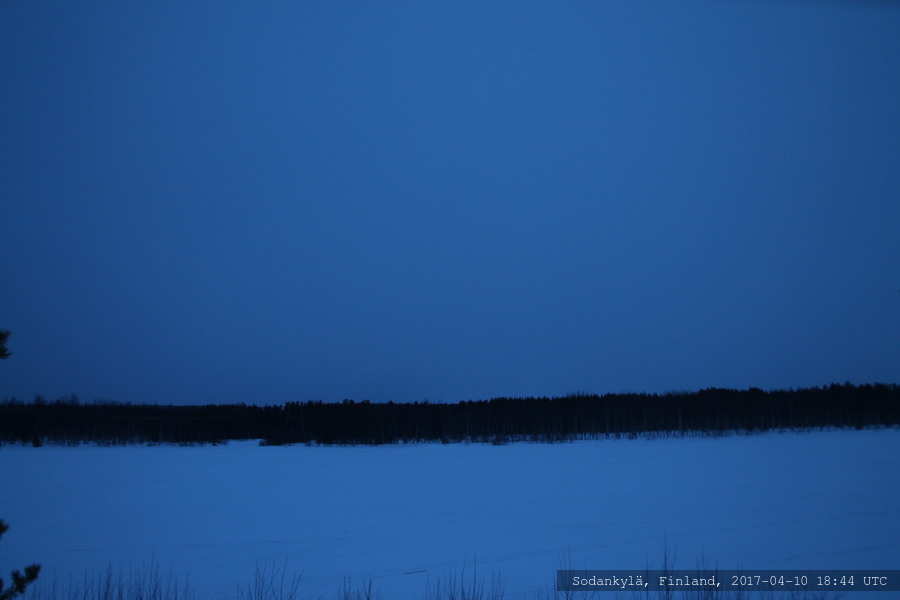
The nights are getting brighter, and we are rapidly approaching the Polar Day, when the Sun does not set anymore for many weeks. The All-Sky Camera of SGO requires that the Sun has set at least 10° below the horizon before it will start up to take images of the night sky and the aurora if there's any. On Friday, 24th April, the Sun will not set below –10° elevation, and thus the camera operations have now been stopped for the summer. The next time the Sun goes low enough in the night is on 19th August. Thus from our auroral camera's point of view, the Polar Day is about to start, and it will last for 117 days!

Please note that for operational reasons, SGO's All-Sky Camera will not be immediately available from 19th August onwards, but of course we try to make the real-time images available as soon as feasible.

The image above (click to get a larger version), shows the light conditions in 2015 for the location of our All-Sky Camera. On the horizontal axis there are key dates for this year. On the vertical axis are the number of hours of darkness. Yellow refers to daytime, i.e. the Sun is above the horizon, and in the middle of the year, there are some 44 days when the Sun does not set at all here. The darkest blue refers to the time when the Sun is 18° or more below the horizon. This is considered total darkness.

The remaining shades of blue refer to the twilight: the lightest blue represents civil twilight, when the Sun is between 0° and 6° below the horizon, i.e. the time just before sunrise or after sunset. The next darker blue with the green line refers to nautical twilight when the Sun is between 6° and 12° below the horizon. The green line shows the limit for the All-Sky Camera, when the Sun is 10° below the horizon. The remaining shade of blue refers to astronomical twilight when the Sun is between 12° and 18° below the horizon.

The green line goes to zero (no darkness anymore) on 24th April and rises again on 19th August. In the middle of winter, the Sun remains for more than 16 hours low enough for our camera to operate.

Furthermore, we can see that just around winter solstice, the Sun does not rise at all during four days. However, it is not totally dark thanks to the prolonged civil twilight time and usually bright, snow-covered land.

Graphic and solar data: Thomas Ulich.

Friday, 27 March 2015

Northern Lights on 25th March 2015


On the evening of 25th March, 2015, we once again saw nice Northern Lights above Sodankylä. First it looked like it might end soon, then some clouds came in, it was a situation when it is not quite clear whether or not it's worth to stay outside and take photos. The solution: take a camera timer, set it to one frame per 15 seconds, keep the camera running pointing in some reasonable direction, and keep finger crossed. Then warm up inside and be ready to rush out if there's something happening.

After some 90 min and 360 photos, there was enough material for a time lapse film. Click the photo to watch it.

Photos and film: Thomas Ulich.

Thursday, 12 February 2015

Field work at the Kjell Henriksen Observatory

This week, the Master and PhD students in Arctic Geophysics at the University Centre on Svalbard (UNIS) are going up to the Kjell Henriksen Observatory (KHO) every evening to do some field work.  To get up to the observatory, we first need to drive to Mine 7 on Adventdalen and then have a ten-minute drive to KHO in a so-called bandwagon. Quite an experience...

The bandwagon.
Photo: M. Grandin

Many optical instruments make auroral observations at KHO and monitor the geomagnetic activity. First, there are several UNIS cameras to record the auroral emission above KHO, among which: a DSLR all-sky camera, taking colour images with a resolution ranging between 5–30 s, an all-sky video camera with 25 ms time resolution and a narrow-field monochromatic imager enabling to study fine structures within the auroral arc when it fills the field of view. Imagers owned by other institutes (University of Oslo, Finnish Meteorological Institute, University College London...) are also set up at KHO.

The meridian scanning photometer at KHO (owned by UNIS).
Photo: M. Grandin

The instrument on which we focus the most is the meridian scanning photometer (MSP). It measures the number of photons reaching the detector in order to provide the intensity of the auroral emission. Thanks to a rotating mirror, a scan of the sky along the geomagnetic north-south direction is made every 4 s. When an auroral arc is present, since it is generally oriented along the east-west direction, its elevation as seen from the observatory is recorded. By making a keogram out of the data, it is therefore possible to track the movement of the aurora across the sky. We made an absolute calibration of the MSP last night. This operation is generally performed about three times in the aurora season.
Tonight, we will do some bigger work: we need to make the absolute calibration of three spectrometers. We will mostly work outside, keeping two people to watch for polar bears and getting some others climb onto the roof of KHO. It should be quite chilly (around -30°C) but fortunately without too much wind...

A photomultiplier similar to the one used by the meridian scanning photometer.
Photo: M. Grandin

As a bonus, it turns out that we have been very lucky weather-wise, as we were granted clear skies for our first two nights onsite. Cherry on the top, we even got some aurora (i.e. good data to analyse later)! Although it was quite cold outside – around -25°C –, we of course found enough motivation to go out to take some pictures.

Group picture under the aurora!
Photo: D. Billett

Friday, 6 February 2015

Lapland Aurora Statistics 2015

Below is the (updated) statistics of the northern lights in Sodankylä in Finnish Lapland. These statistics show the probability of northern lights. More detailed information can be found at http://www.sgo.fi/Data/AllSky/allskyFAQ.php.

Recently, we have had rather strong auroral activity. As the weather in Sodankylä seems to be good this weekend, so we are looking forward to seeing some auroras!


Thursday, 16 October 2014

Aurora pictures 14.10.13

Another active night in Sodankylä this autumn! Wonderful displays started to show up as early as 20:00 Finnish time. The following pictures were taken between 20:00 and 23:00 near the small airport of Sodankylä.


Pictures: Maxime Grandin

Friday, 10 October 2014

Aurora pictures 09.10.14

After many cloudy days, last night's clear skies enabled to enjoy the northern light! It started to be quite active around 23:00 Finnish time and pretty nice arcs danced during a rather long active phase. Here are a few pictures...


Finally another photo taken at a different location in Sodankylä, on the banks of the river Kitinen. The landscape is eerily bright thanks to the near-full moon, and the lack of wind turned the river into a perfect mirror for northern lights! 


Photos: Maxime Grandin (top three photos) and Thomas Ulich (bottom photo).

Wednesday, 1 October 2014

Last night...

Last night the Northern Lights were active again, but this time, unlike the previous night, the sky was clear. Here's a photo from early on, at 22:23 h (local time), i.e. 19:23 UTC.
The activity continued through most of the night, even increasing to a total of 600 nT (fullscale) storm, which must have been visible over most of Finland and Scandinavia.

When you look at our real-time magnetogram, like the one above, always look for sharp drops in the X component (red). Large changes in short time mean that the Northern Lights are most active and beautiful, and you shouldn't be looking at the computer, but at the sky. The trick is to anticipate the moment and be ready to run out right away... Good luck hunting for the Northern Lights!

Photo: Thomas Ulich (8s, 400ISO, f/1.4)

Tuesday, 23 September 2014

Aurora pictures 22.09.14

Last night was pretty active around Sodankylä, geomagnetically speaking. The northern light appeared around 22:00 local time and lasted for several hours. It was mostly of the pulsating kind, which is very fascinating yet not particularly impressive on pictures. Still, here are a few ones.


Saturday, 13 September 2014

Revontulia nähty ja lisää varmaan tulossa

Perjantaiset revontulet (Kuva: Markku Inkilä www.facebook.com/airphotolapland)
Keskiviikkoinen auringon X1.6-tason röntgensädepurkaus, joka siis liittyi koronan massapurkaukseen, tömpsähti maahan perjantaina alkuillasta. Shokkiaallon saavuttua magnetosfääri puristui kasaan. Observatorion magnetogrammissa mittasimme noin 400 nanoteslan muutoksen parin tunnin aikana. Revontulet tulevat näkyviin kun ionosfääriin tulee ionisaation takia voimakkaampia virtoja. Tämä näkyy magnetogrammin X-komponentin muutoksesta. Lisäksi ns. Bz-komponentin pitää olla negatiivinen. Sopivaa yhdistelmää revontulia varten saatiin odottaa melkein puolille öin. Silloinhan ne rävähtivät taivaalle. Markku Inkilä saikin napattua oheisen kuvan Inarin kunnassa. Lisää Markun kuvia näet täältä!

Lauantai-illan tullen saatamme nähdä lisää revontulia! Sääennuste näyttää ihan kohtuulliselta, joskin Bz-komponentti on vääränmerkkinen. Toivotaan siis sen muuttuvan!

Aurora pictures 12.09.14

Although the beginning of the night was not very promising, the sky being almost overcast, I managed to take a few pictures of the northern light this night. 

The sky started to clear up around 23:45 and some activity could be guessed behind the clouds.


As the last clouds were drifting from the western horizon towards Sodankylä, a diffuse aurora appeared in the south.


Around 1:15, a proper arc finally showed up, offering gorgeous displays of green and purple.


A few minutes later, a quite active arc appeared in the north. Unfortunately, it lasted only for a couple of minutes.


Slightly tired and feeling cold, I decided to stop hunting a bit after 2:00. Finally, this night's displays were not as impressive as I had hoped, but they were still worth staying up to enjoy them.