
Tuesday, 28 October 2014
Revontulitalvi alkanut näyttävästi
SGO:n kamerat on kuvanneet Lapin taivasta noin kahden kuukauden ajan ja taivaalla on nähtävää riittänyt 70% öistä. Yleensä syys-lokakuu on pilvistä ja sateista aikaa, mutta tänä syksynä ainakin Lapissa on riittänyt ihan hyvin selkeääkin säätä revontulien havainnointiin. Varsinainen pimeän aika kestää jo 13 tuntia päiväpituuden jäädessä Sodankylän korkeudella alle 8 tunnin. Talviaikaan siirtyminen myös helpotti iltaunisten mahdollisuuksia nähdä revontulia. Alla koko viime yön revontulet, jotka päättyivät sykkiviin revontuliin aamun sarastaessa puoli seitsemän aikaan. Syksyn revontuliyöt löydät SGO:n galleriasta aina 27.-28.10. yöhön saakka.

Research Ethics
Euthanasia, animal testing, biofuels, Milgram experiment... Although in physics we do not have the same ethical issues as in biology, medical science or psychology, there are quite a few situations a physicist encounters in his scientific life which require being careful, be it while processing data, publishing a paper or making public statements. This blog post itself has been ethics-checked with the utmost care and contains no plagiarism nor bear any kind of conflict of interest.

In the University of Oulu, all the doctoral students are required to take a Scientific Research and Ethics course during their PhD. For some of them, it is a topic they never dealt with before.
THINK BY THEMSELVES
This course consists of a couple of general lectures introducing the concept of ethics from a philosophical point of view, followed by several field-specific lectures. This enables to treat differently the students in medicine or biology who may open people or animals to publish scientific papers, students in humanities who may make statistics from personal data to publish scientific papers and students in physics or mathematics who may publish scientific papers. Finally, a group work on a research-ethics-related topic and leading to a presentation during a seminar allows the students to think by themselves about what ethics involves, based on a concrete case.
And for those students who may fail this ethics course in this autumn term, another one will be held next spring. In Finnish. Lesson no. 1: don't mix it with vinegar.
Monday, 27 October 2014
Solar flare signature in the BDU riometer
There has been quite inspiring buzz in the media about the current "monster sunspot", and indeed, this giant AR2192 spot has sent multiple X-class solar flares towards us within the past few days. In addition to the widely reported HF-radio blackouts and GPS navigation disturbances, the energetic solar flares cause changes in the upper atmosphere/ionosphere due to increased photoionisation in the whole dayside hemisphere. SGO aims to quantify this ionisation by several ground-based measurement techniques, including riometers.
As mentioned in the earlier blog, we have just installed a new spectral riometer to Bahir Dar, Ethiopia and we were lucky to catch a few of these fresh solar flare events to the data, please have a look:
As mentioned in the earlier blog, we have just installed a new spectral riometer to Bahir Dar, Ethiopia and we were lucky to catch a few of these fresh solar flare events to the data, please have a look:
 |
| Received power (in arbitrary dB units) detected by the BDU spectral riometer (start, max and stop times of the solar flare event are marked as dashed lines). |
One of the challenges in detecting the solar flare induced ionisation by riometry is that the Sun sends, not only the X-rays, but also bursts of radio emissions related to the flare events. As the riometer operates at the same radio frequencies, these emissions might mask totally the signature of the atmospheric response to the flare, i.e., reduction in the cosmic radio noise levels.
In this case too, the increased levels of radio noise (red stuff) during the onset and offset phases of the flare are probably caused by the direct solar radio emissions. However, around the maximum time of the flare, there is a clear reduction in the radio noise, most likely caused by increased radio wave absorption in the ionosphere. We are particularly interested in the spectrum of this increased absorption (radio noise absorption at different frequencies) as it carries information on the ionisation profile in the atmosphere.
This provides a very nice science case for collaboration between the SGO and BDU scientists and pretty awesome kick-off for this instrument, I'd say!
A few photos of the famous beauty & the beast:
 |
| www.spaceweather.com |
 |
| www.spaceweather.com |
Sunday, 26 October 2014
Ethiopia vs. Finland: 6-4
 |
| Group photo of both teams! (Photo by Atte Penttilä) |
I am sure that Finland will win next year ;) !!
 |
| Hiipivä piilokärki, piilotettu lohikäärme Finnish 'libero'! |
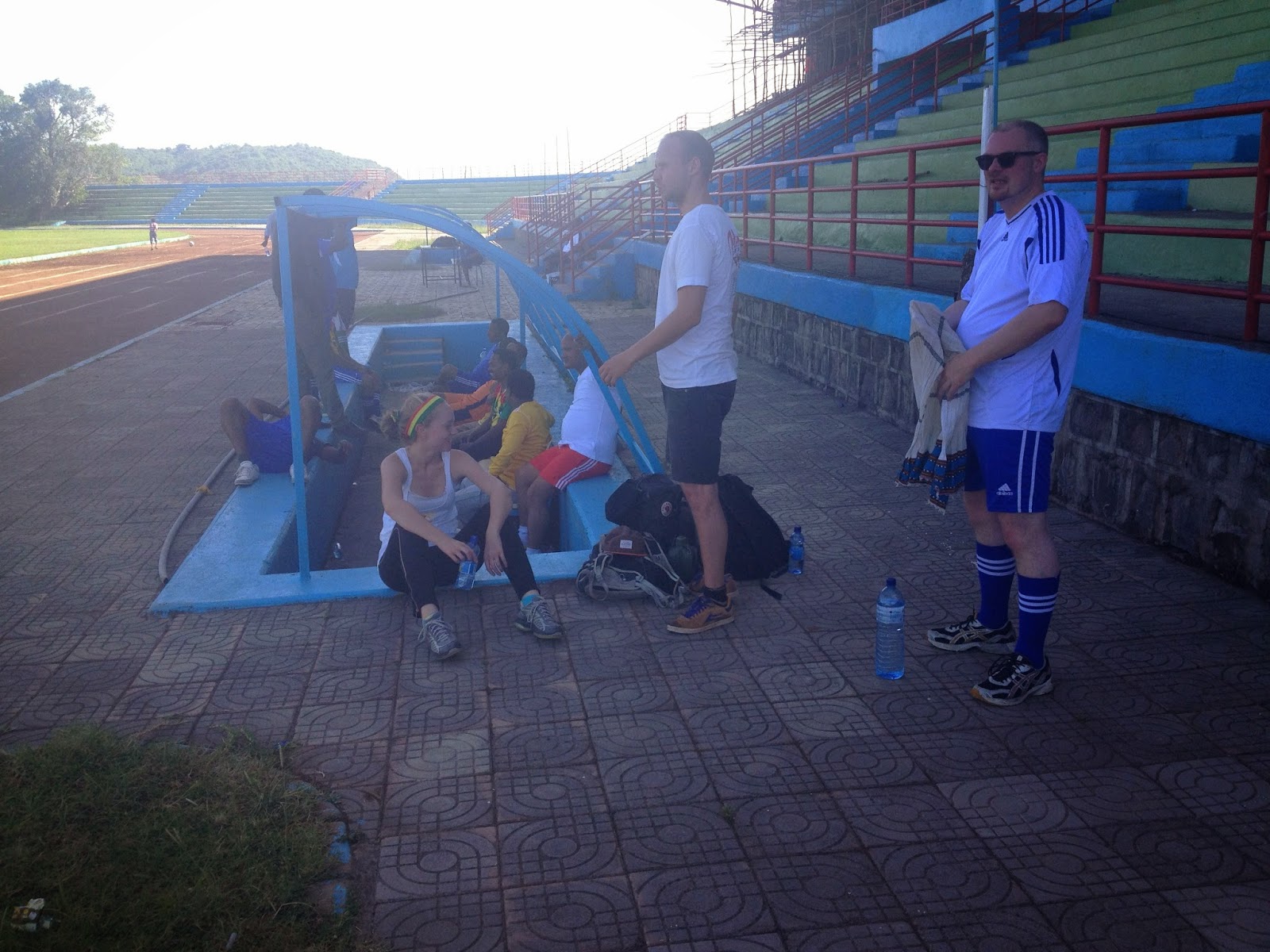 |
| Preparations for the match! |
 |
| ... and here's the stadium and match in progress. |
 |
| This year, we did not have much audience... |
Thursday, 23 October 2014
Greetings from Bahir Dar University, Ethiopia!
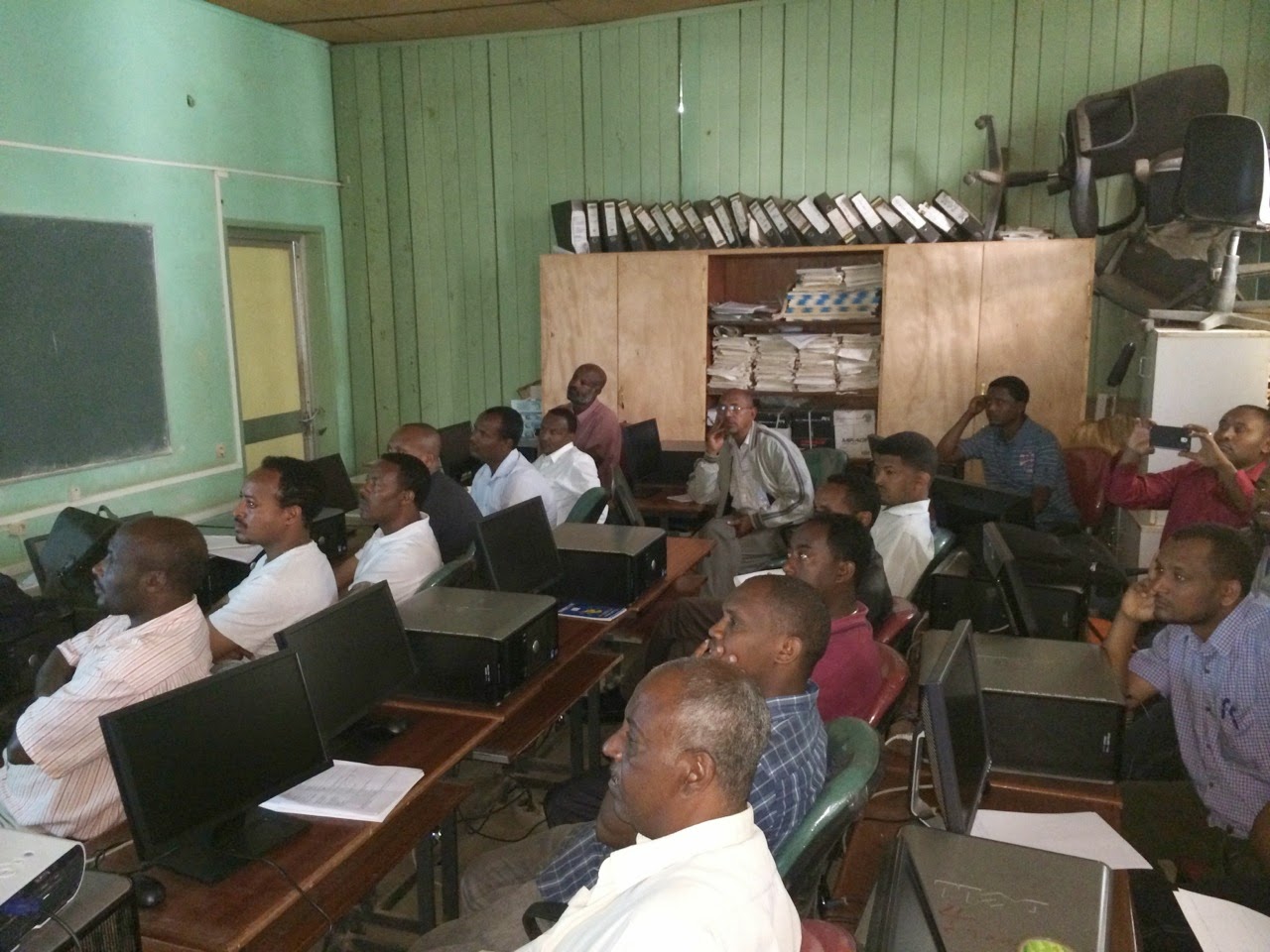 |
| The interested audience |
SGO team is back in business in Bahir Dar University, Ethiopia! This time, it’s only me and Antti taking part in the expedition. The first effort was to install a spectral riometer. This effort was covered in a previous web log posting. The instrument is now running and we hope to get some results, especially as we had an X-class solar flare yesterday evening at ~17.00 LT. However, we have still some technicalities with the instrument, so it’s bit nerve-racking.
This week, we have given a series of seminar talks and will continue with the talks also next week. On Friday afternoon, we will have the traditional football Finland vs. Ethiopia - let’s see who will win the ‘classic’! This will be 4th match, the first one was played in 2011; and then new matches in 2011 and 2012. Ethiopia has won two of these
 |
| Lassi talking ionospheric tomography |
Antti will depart back to Finland next week Wednesday, but I will stay all the way until November 14. My purpose is to submit one paper, which we have been doing with Abiyot. We have couple other manuscripts in preparation. Hence, it will be a good paper writing session! In addition to this, we have learned that our US colleagues are coming down to Bahir Dar early November to install the VHF coherent backscatter radar. So, I am hoping to have a chat with them also.
 |
| Antti talking on ionosphere, magnetic fields and electrons |
Wednesday, 22 October 2014
EISCAT Radar Time Available for Anyone!

While evaluations are merit based, in the case of two applications having similar merits in evaluation, preference will be given either to those applicants who are new to the EISCAT facilities, in order to enlarge the EISCAT user community and further more open access to the facilities, or to the applicant showing stronger educational impact in their proposal.
The present call is the first one for 2015. In total, 200 hours of experiment time are open for international, peer-reviewed competition, and are available for the use of any of the current EISCAT facilities. Roughly half of this time has been allocated in the first call.
For more information, please refer to the EISCAT Peer-Review Programme: Call for Proposals.
The deadline for proposals is 1st November 2014 at 24:00 UTC.
Photo taken just outside the feeder bridge of the EISCAT VHF Radar in Tromsø by Thomas Ulich.
Tuesday, 21 October 2014
Riometer installed at Bahir Dar, Ethiopia!
This box has been on its way to Bahir Dar University for quite some time, mostly stuck in the local custom station, but now it's finally here, installed on the roof of the physics lab. The riometer consists of one LOFAR LBA antenna element (in the picture), amplifier, USRP sampler and a computer calculating the cosmic radio noise spectra.

This will be the first riometer installed into the magnetic equator, i.e., under the most magnetically shielded volume in the ionosphere. Therefore we expect to detect mostly variations in the solar photoionisation (such as solar X-flares). Moreover, it will be interesting to see, if the most energetic solar protons are detectable in the data during solar proton events. Plus, there is always a chance to find out something new & unexpected from the places nobody has been searched before.
Yes, yes, yes, yes, yes! Finally!
Subscribe to:
Posts (Atom)