Friday, 29 July 2016

Incoherent Scatter Radar School: Analysing Experiment Data

As the end of the radar school is already approaching, a greater and greater part of the programme is dedicated to group work. Yesterday, the morning lectures were essentially focusing on analysing the incoherent scatter radar (ISR) data and fitting the ISR spectrum to extract ionospheric parameters. Other lectures had a more scientific focus and showed examples of ionospheric phenomena which can be studied with ISRs. One more lecture aimed at underlining the importance of keeping a critical view on the analysed data before drawing scientific conclusions.

In the afternoon, the group work on the analysis of Tuesday night's data was continued. Most groups managed to come up with a clear plan on how to divide tasks, which features in the data to focus on, and which additional data sets to look at.

Group 5 looking for particle precipitation signatures in their data.
Photo: C. Heinselman
This all looks very promising for the presentations of Saturday morning. It seems that each group have their own scientific focus, which makes it all the more interesting. Let's see how far they manage to get by this evening!

Thursday, 28 July 2016

Incoherent Scatter Radar School: Excursion in Luosto

After the experiment night, it would have been hard to attend lectures in the morning. So instead, an excursion was organised in Luosto. Students and teachers were divided into six teams and took part to a treasure hunt around the Ahvenlampi pond. With each step came a short text about a "Finnish Fun Fact", along with a related question aimed for providing a few insights on Finnish culture.

Initially, the weather was very nice, and there were only few mosquitoes. Participants came across a lot of bilberries, and several of them could even find cloudberries. The end of the treasure hunt was however somehow precipitated by the arrival of a thunderstorm with heavy rain. Coffee was served in the small laavu where the whole party just fit, before all retreated to the restaurant of the local hotel. As a souvenir, participants were all given a small amethyst stone from the Lampivaara mine – the only active one in Europe – located a few kilometres away from Ahvenlampi.

The Red team fishing a hint.
Photo: C. Heinselman

Lectures resumed in the afternoon, and students could then download the data of their experiments and started to analyse them. In the evening, the workshop banquet allowed our guests to try poronkäristys (sautéed reindeer) and cloudberry pannacotta. Those who were not completely exhausted after the experiment night and the morning treasure hunt were also given the opportunity to experience Finnish sauna at the observatory.

And we are half-way through our radar school already!

Wednesday, 27 July 2016

Incoherent Scatter Radar School: Experiment Night

One of the highlights of the Radar School is the experiment night, which took place yesterday. The participants were divided into groups of 5 to 6 people and had to design a radar experiment to be run using EISCAT.

After the morning lectures providing students with some background on the incoherent scatter theory, pulse coding and experiment configuration, each group was asked to come up with a scientific focus related to the ionosphere (study of a particular region, feature, or process). Based on their topic of interest, they had then to discuss what kind of trade-off they could reach in order to obtain the best possible data. Which altitude and latitude do they want to observe? Is there a preferred magnetic local time for the features they are interested in? What time and range resolution do they need? Is there an optimal pointing direction or scanning pattern in their case?

Once the group agreed on the answers to those questions, they could write a proposal of experiment for either the EISCAT mainland VHF radar or the EISCAT Svalbard Radar (ESR), and request a 2-hour time slot between 17:30 and 01:30 local time. The proposal needed to mention which experiment code should be run, and the desired pointing direction. All those details were submitted to the lecturers, who evaluated them and notified acceptance within 10 minutes, to start with the first experiment less than 30 minutes later (as someone pointed out, this is a once-in-a-lifetime situation!).

Monitoring the polar cap convection with ESR.
Photo: E. Turunen

The experiments were run from the lecture hall of the Polaria building in SGO, by the students themselves, under the supervision of lecturers with experience as EISCAT users. The experiment time slots were intertwined with "radar walks" around Tähtelä, during which the main on-site instruments were briefly presented (and local mosquitoes were properly fed).

During one of the "radar walks" at SGO.
Photo: C. Heinselman

For the rest of the week, participants will retrieve and analyse their data. More on that in the coming days!

Tuesday, 26 July 2016

Incoherent Scatter Radar School: Let's Get Started!

This week, Sodankylä Geophysical Observatory is hosting the Incoherent Scatter Radar School jointly organised and sponsored by EISCAT/SGO and the National Science Foundation (NSF)/SRI International. A total of 39 participants coming from institutes over 13 countries (and of 20 nationalities), are taking part in this radar workshop. The summer school also involves 15 motivated lecturers and organisers from Europe and the United States.

Most participants arrived on Sunday morning, after a night on the train between Helsinki and Rovaniemi (oh yes: to make it easier, we managed to get Rovaniemi airport closed this month). As the bus was heading to Sodankylä, most of them crossed the Arctic Circle for the first time in their lives.

Once in Sodankylä, and after having a delicious lunch and settling down at the student accommodation at Lapin Ammattiopisto, those who were interested were given the opportunity to take part in a walking tour of the village. The weather was exceptional, which certainly contributed to encourage our guests to try salmiakki icecream in front of the K-supermarket. Tervetuloa Suomeen!

The EISCAT receiver in Sodankylä (a little bit hidden behind a group of people)
Photo: T. Ulich

The official programme started yesterday morning with lectures presenting Sodankylä Geophysical Observatory and introducing ionospheric physics and basics of radar theory. In the evening, a small home-made radar demonstration showed how with relatively simple electronics and computing power it is possible to measure the speed or the range of a given target.

This has been a very promising start, and there is even more to come. To be continued...

Monday, 16 May 2016

April Aurorae


Recently, we reported about a new long-term time-lapse project at SGO. Today, we have received the summary video of the Northern Lights in April. The video above works best in full screen and high definition.

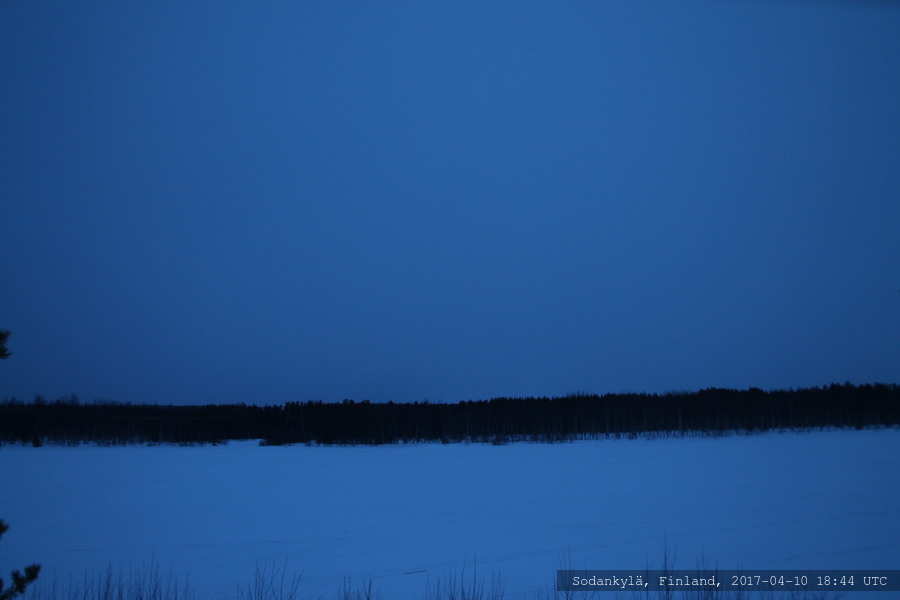
Also, we now have live feeds from the time-lapse cameras to SGO's web pages, which allow you to check the current weather conditions in real time. The images are updated once per minute.


As an example, here's what our river camera sees at the moment. You see both images on on their dedicated live-feed page. Enjoy!

Text: Thomas Ulich; image and film: Site-Eye Ltd.

Saturday, 23 April 2016

New Time-Lapse Project at SGO

Since February 2016, Sodankylä Geophysical Observatory provides the operational platform and support for a joint long-term time-lapse project in collaboration with Site-Eye Ltd., UK. Two cameras have been installed in Sodankylä, which both take a photo every minute. One of the camera looks at the sky, the other looks at the river Kitinen flowing past the Tähtelä site of SGO.


The cameras will be recording 4K time-lapse footage for the next 12 months, with monthly highlights published on-line. Above's a taste of what's to come, the time-lapse film of the sky in March 2016.

Slow Scan Photography


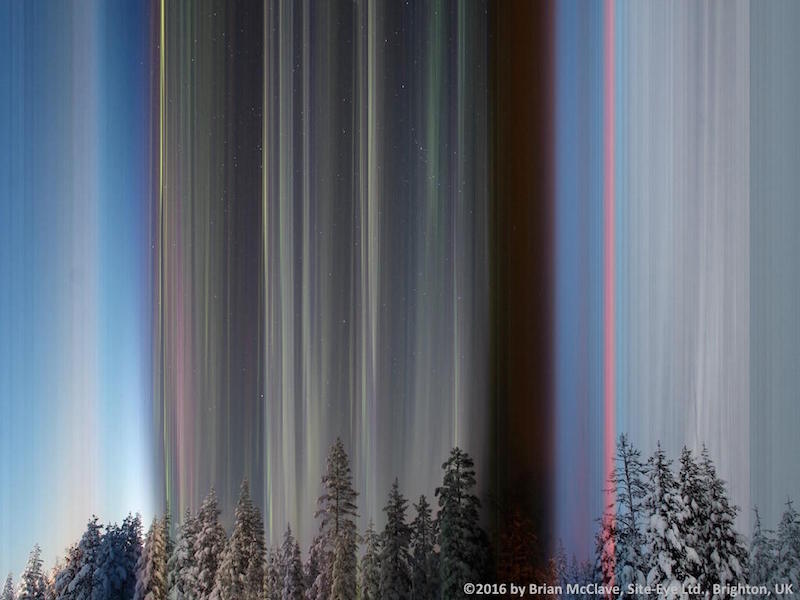
The so-called Slow Scan Photograph by Brian McClave of Site-Eye, summarises one night of beautiful aurora above Sodankylä. The image was taken over a period of 24 hours, at a rate of one image per minute. The Slow Scan Photograph is then composed by vertical slices of the original 1440 images. In this composite image, time progresses from left to right. The green aurora is clearly visible, mixed with some grey clouds, and there's a fantastic red dawn in the early morning.

Enjoy.

Text: Thomas Ulich; images and film: Site-Eye Ltd.

Wednesday, 9 March 2016

Radar School 2016 - Extended Deadline 15.03

The deadline for submitting applications to the Incoherent Scatter Radar School jointly organised by EISCAT (Europe) and NSF (US) is extended until 15th March. The school will be held in Sodankylä from 24th to 30th July 2016.

Candidates who have not yet sent their application are invited to follow the instructions on the following webpages:
- US participants: http://www.amisr.com/workshop

For any inquiries, please contact RS2016(at)sgo.fi (EISCAT/SGO) or summerschool@esd.sri.com (US NSF).

Selected participants will be notified by 29th March 2016.

Blue and green: Sodankylä in July.
Photo: M. Grandin